
By ZMT Primary Healthcare Network | zmtclinics.org
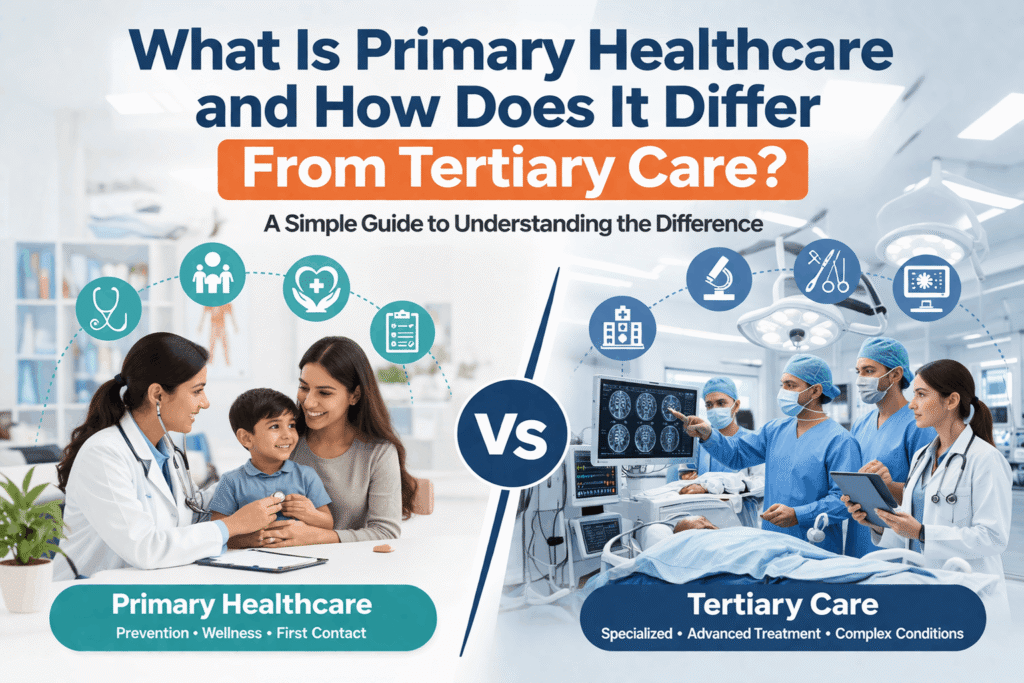
Here’s a question most people in Pakistan have never been asked — and probably can’t answer:
What’s the difference between primary, secondary, and tertiary healthcare?
It sounds like a textbook question. But the answer has real, life-or-death implications for millions of families in Karachi and across Pakistan.
When people don’t understand how the healthcare system is supposed to work, they make decisions that harm them: skipping the clinic for months until they end up in the emergency room. Going straight to a specialist for a problem that a family doctor could have solved. Paying Rs. 5,000 for a hospital visit when a Rs. 500 consultation would have been both adequate and timely.
In this article, we’re breaking it all down — clearly, practically, and in the context of Karachi’s healthcare reality. And we’re explaining why primary healthcare isn’t just the first level of care. It’s the most important one.
The Three Levels of Healthcare: A Framework
Modern healthcare systems are organized into three tiers:
Primary Healthcare (Level 1)
Primary healthcare is first-contact care — the first place you go when you have a health concern. It’s the foundation of the entire health system.
Primary healthcare covers: – General consultations for common illnesses – Preventive care and health screenings – Chronic disease management (hypertension, diabetes, asthma) – Maternal and child health services – Vaccinations and immunizations – Mental health support – Health education and counseling – Rehabilitation and basic physiotherapy
Primary healthcare is delivered by general practitioners (GPs), family physicians, community health workers, nurses, and paramedics — in clinics, health centers, and community settings.
The key characteristics of primary healthcare: – Accessible (geographically and financially) – Continuous (ongoing relationship between patient and provider) – Comprehensive (covers a broad range of needs) – Coordinated (manages referrals to higher levels when needed) – Community-oriented (designed around the needs of a specific population)
Secondary Healthcare (Level 2)
Secondary healthcare is specialist-level care — accessed when a primary care provider determines that a patient needs more specialized evaluation or treatment.
Examples include: – Cardiology consultations for a heart condition – Orthopedic assessment for a complex fracture – Gynecology and obstetrics for high-risk pregnancies – Specialist surgery (appendectomy, hernia repair, etc.) – District general hospitals
Secondary care is typically accessed through referral from a primary care provider.
Tertiary Healthcare (Level 3)
Tertiary healthcare is the most complex, specialized, and resource-intensive level of care — delivered in major hospitals with highly specialized technology and expertise.
Examples include: – Open-heart surgery and cardiac catheterization – Cancer treatment (chemotherapy, radiation, complex surgical oncology) – Organ transplantation – Neurosurgery – Intensive care units (ICU) – Neonatal intensive care (NICU) for critically ill newborns
Tertiary care facilities include institutions like Aga Khan University Hospital, Jinnah Hospital, and similar major centers.
Why the Distinction Matters: Pakistan’s Upside-Down Healthcare System
Here’s the problem in Pakistan — and it’s a serious one.
The healthcare system is functioning upside down.
In a well-functioning system, primary care handles the vast majority of health needs — estimates suggest 80–90% of all healthcare encounters should be managed at the primary level. Patients flow upward to secondary and tertiary care only when their needs genuinely exceed what primary care can handle.
But in Pakistan, primary healthcare is chronically underfunded, undervalued, and inaccessible to the poor. The result? People skip primary care entirely and go straight to secondary or tertiary facilities — for problems that should have been handled at the clinic level.
The consequences are devastating: – Massive overcrowding at government hospitals and major healthcare centers – Delayed care for genuinely critical patients because hospital resources are consumed by manageable conditions – Enormous financial burden on families who pay tertiary-level prices for primary-level needs – Preventable deaths because conditions that should have been caught at the primary level become crises by the time they reach hospital
As we explored in The Importance of Primary Healthcare for Karachi’s Underserved Communities, many areas in Karachi’s slums have no accessible primary care whatsoever. This is the healthcare gap that ZMT was founded to fill.
Primary vs. Tertiary Care: A Side-by-Side Comparison
| Feature | Primary Care (e.g., ZMT Clinic) | Tertiary Care (e.g., Major Hospital) |
| Focus | Prevention, early detection, common illness | Complex, specialized, critical conditions |
| Setting | Community clinic, health center | Major hospital, teaching hospital |
| Provider | GP, family doctor, community nurse | Specialist, sub-specialist, surgeon |
| Cost | Low to nil | Very high |
| Wait time | Typically same day | Often days to weeks |
| Accessibility | Community-based | Centralized, often far from underserved areas |
| Conditions treated | 80–90% of health needs | Complex 5–10% requiring specialization |
| Continuity | Ongoing patient-doctor relationship | Episodic, condition-specific |
| Preventive focus | Core function | Minimal |
The takeaway is clear: primary and tertiary care are not competitors — they’re complementary. A functional health system needs both. But it needs a strong primary care foundation to work efficiently.
The WHO’s Primary Healthcare Vision
The World Health Organization (WHO) has consistently argued that Universal Health Coverage (UHC) is only achievable through strong primary healthcare systems.
The 1978 Alma-Ata Declaration — one of the most important documents in global health history — proclaimed that primary healthcare is “essential healthcare made universally accessible to individuals and families in the community.” It argued that primary healthcare should be the first element of a continuing healthcare process.
Nearly five decades later, Pakistan is still struggling to realize this vision.
The 2018 Astana Declaration reaffirmed the primacy of primary healthcare in achieving health equity. But declarations alone don’t save lives. Organizations like ZMT — funded by the generosity of Zakat and Sadaqah donors — are doing the actual work.
What Conditions Does Primary Healthcare Manage?
A surprisingly large percentage of conditions — even ones that sound complex — can be effectively managed at the primary care level.
Acute conditions commonly managed in primary care: – Upper and lower respiratory infections – Urinary tract infections – Skin infections and dermatological conditions – Ear, nose, and throat conditions – Gastrointestinal illness (gastroenteritis, constipation, peptic ulcer disease) – Minor injuries, wounds, and sprains – Fever of common causes
Chronic conditions managed in primary care: – Hypertension (high blood pressure) – Type 2 diabetes – Asthma and COPD – Thyroid disorders – Depression and anxiety – Epilepsy (maintenance treatment) – Chronic back pain
Preventive services delivered in primary care: – Childhood immunizations – Antenatal and postnatal care – Cancer screening (cervical, breast) – Cardiovascular risk assessment – Nutritional counseling
The key insight: When primary care is accessible and functional, the vast majority of these conditions are managed effectively — cheaply and quickly. When primary care is absent, they accumulate, worsen, and eventually present as expensive emergencies.
ZMT’s Role in Pakistan’s Primary Healthcare Landscape
ZMT is deliberately positioned at the primary care level — not because primary care is “easier,” but because it is more impactful per Rupee than any other level of care.
As described in our Comprehensive Guide to ZMT Primary Healthcare Services, ZMT’s 45 clinics across Karachi provide:
- General outpatient consultations
- Maternal and child health services
- Vaccination
- Laboratory diagnostics
- Free medicines
- Hepatitis C treatment
- Mental health support
- Physiotherapy
- Eye care
- Malnutrition management
Every one of these services is a primary healthcare function. Every one of them prevents the conditions that would otherwise end up as expensive, often fatal, tertiary care emergencies.
ZMT is doing what the government health system has failed to do in Karachi’s underserved communities: provide a functioning, accessible, comprehensive primary care network.
The Referral Function: When Primary Care Sends You Onward
An important and often misunderstood function of primary care is the referral decision — recognizing when a patient’s needs exceed what primary care can manage and connecting them to appropriate secondary or tertiary resources.
ZMT’s clinical team does this regularly. When a patient presents with a condition that requires specialist evaluation — a suspicious lump, an unusual cardiac finding, a serious eye condition requiring surgical intervention — our doctors provide the appropriate referral letter and guidance.
This is the gateway function of primary care: we don’t just treat what we can. We identify what requires more, and we make sure patients get to the right place.
Why Zakat and Sadaqah Invested in Primary Healthcare Create Maximum Impact
From an Islamic charity perspective, the question is: where does your giving create the most good?
The answer, supported by decades of global health data, is: primary healthcare.
Here’s why:
- Cost-effectiveness: Primary care interventions — vaccines, blood pressure management, antenatal care — cost a fraction of the tertiary interventions they prevent. Your donation goes further.
- Breadth of impact: One primary care clinic serves thousands of patients. One tertiary hospital serves far fewer, at far greater cost.
- Community-level change: Strong primary care systems create healthier communities — not just healthier individuals. The benefits compound over generations.
- Alignment with Zakat principles: Zakat is meant to support those in genuine need. Karachi’s underserved communities — who lack any access to primary care without ZMT — are exactly the people Zakat is designed to help.
- Sadaqah Jariyah: Healthcare as ongoing charity means that a funded clinic keeps delivering benefits long after a donation is made. Your Sadaqah today heals patients for years.
ZMT is one of the most transparent and accountable Zakat-eligible healthcare organizations in Pakistan. Every donation is tracked and used exclusively for patient benefit.
Understanding Where ZMT Fits in the Healthcare Hierarchy
Think of Karachi’s healthcare system as a pyramid:
- Top (narrow): Tertiary care hospitals — Aga Khan, Jinnah, Liaquat National — complex, specialized, expensive
- Middle: Secondary care — district hospitals, specialist clinics — moderately accessible
- Base (wide): Primary care — should be the most accessible, the most common point of contact, the foundation
In affluent areas of Karachi, the base of this pyramid exists: private GPs, well-resourced clinics, and family doctors that can be accessed for a few thousand Rupees per visit.
In Karachi’s slums, informal settlements, and underserved suburbs — the base of the pyramid is largely absent. The poor go from having no care directly to the overwhelming emergency rooms of public hospitals.
ZMT is building that missing base — one clinic at a time.
With 45 clinics and counting, and a vision of 100, ZMT is constructing the primary healthcare foundation that Pakistan’s most vulnerable communities have been waiting for.
Final Thoughts
Understanding the difference between primary and tertiary care is not an academic exercise. It’s essential knowledge for anyone who uses healthcare, makes healthcare decisions, or — crucially — supports healthcare through charitable giving.
Primary healthcare is the most important and most neglected level of Pakistan’s health system. It is where prevention happens, where chronic diseases are managed, where mothers are kept alive, and where children grow up healthy.
ZMT exists to fill this gap in Karachi — and it exists because of the generosity of donors who direct their Zakat, Sadaqah, and charity toward this critical work.
If you want to see what primary healthcare looks like in practice, visit your nearest ZMT clinic. Or read more about Affordable Health Check-ups in Karachi: What You Need to Know.
And if you want to support it — donate today at zmtclinics.org.
ZMT Primary Healthcare Network — Quality primary healthcare for every woman and child in Pakistan. Donate your Zakat and Sadaqah at zmtclinics.org
